

Empowering Artists Through Communication
In September 2025, Bucharest hosted a unique learning experience that brought together Romanian communicators, artists, and cultural professionals with the lead Norwegian trainer in a collaborative effort to strengthen communication skills in the creative industries. The Art Press workshop, developed under the Erasmus+ KA210VET action, was not just about teaching public relations; it was about reframing communication as a creative and strategic act. Coordinated by Communication ON (Romania), in partnership with Morten BRUUN (Norway), the project addresses a growing need: to equip cultural professionals with the tools to make their voices heard, their values visible, and their work more impactful in both local and international contexts.
Learning Objectives and Workshop Format
- To develop strategic communication competencies tailored for the arts and culture sector
- To promote authenticity and coherence in public narratives
- To empower participants to map their creative ecosystems and stakeholder relations
- To encourage multidisciplinary approaches in storytelling and advocacy
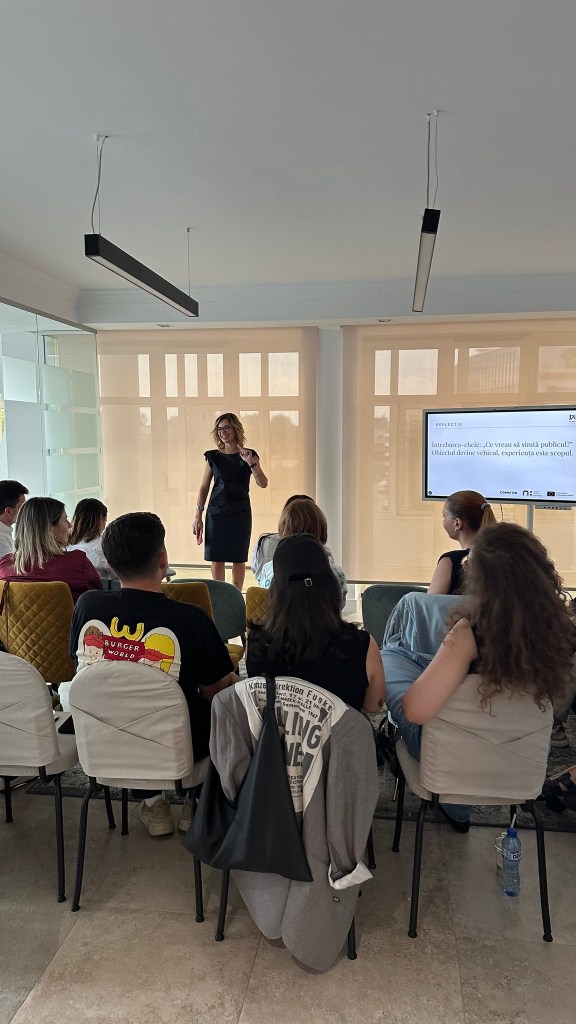
The workshop was conducted in a hybrid format, combining online and on-site sessions. It brought together 31 participants, including artists, PR professionals, designers, curators, and NGO communicators, for two days of intensive learning, reflection, and co-creation.
Led by trainers Teodora Moroșanu, Morten Bruun, Raluca Nicolaescu, and Bogdan Moroșanu, the program not only taught public relations for artists but embodied it as well. It posed questions to every participant: How do you make your art speak? And more crucially: What do you want it to say? How do I tell the story of my work without losing its essence? How can artists and cultural communicators make their work speak clearly, meaningfully, and authentically in a noisy world?
Finding Voice Before Building Reach
The first day opened not with a set of definitions or PR templates, but with a question posed by trainer Teodora Moroșanu that felt more like a provocation than an instruction:
“Is your digital presence amplifying your artistic vision or distorting it?”
Silence followed. Not out of confusion, but recognition. Everyone in the room had posted, shared, and promoted. But few had paused to ask whether their online voice truly reflected who they were as creatives.
That moment of pause set the tone for the day. Participants, ranging from emerging visual artists to senior cultural PR managers, were asked to audit their digital identities. They scrolled through their feeds, reviewed past campaigns, and examined the visual and textual traces they had left across the internet. Some smiled in realisation. Others frowned.
There was no pressure to “fix” or “rebrand.” Instead, the emphasis was on authenticity as alignment, a concept Teodora explored in depth. Authenticity, she explained, does not require constant exposure or public vulnerability. It’s about crafting a coherent presence that aligns with one’s values, creative vision, and audience expectations. One does not need to share everything; one simply needs to share intentionally.
A digital content manager in the group reflected aloud:
“I’ve spent years building stories for other artists. Today is the first time I’ve considered the story I’ve been telling about myself.”
Such realisations were gently but firmly supported through exercises like the Red Thread, a guided reflection designed to help participants identify recurring emotional, thematic, or ethical constants in their work. Some identified justice or memory; others, environmental stewardship or emotional intimacy.
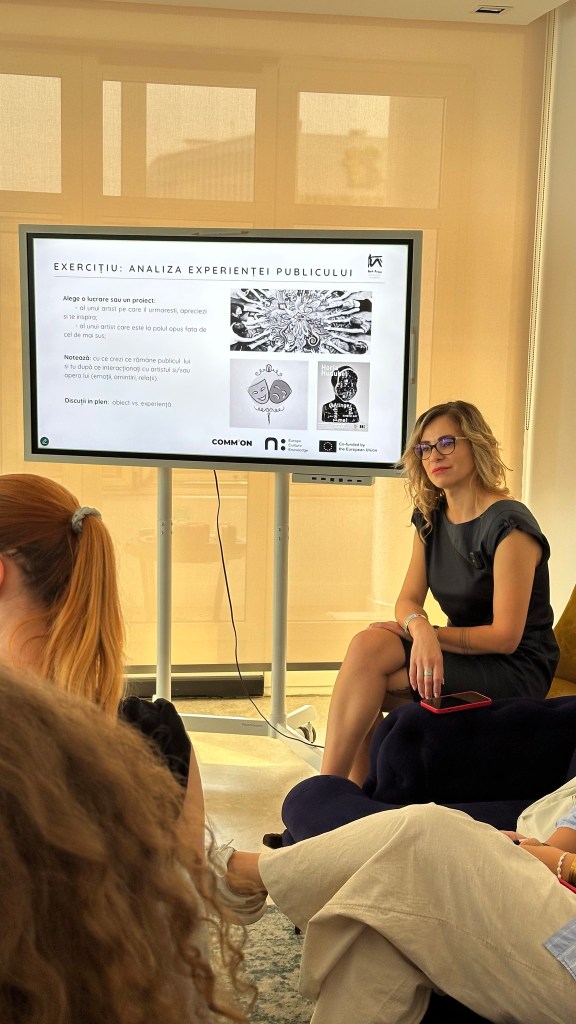
In the afternoon, a session led by trainer Raluca Nicolaescu introduced a subtle shift from introspection to audience perception. Participants were asked to consider not just how they presented their work, but how it is received. In the session titled Experience vs. Object, Raluca posed a question that struck a chord with everyone:
“What do audiences remember when the lights go off?”
The room collectively nodded when the conclusion was drawn, it’s not the brochure, the press release, or even the object of art. It’s the emotion—the lingering sense of meaning and connection.
Structure as Strategy: Day Two in Focus
If Day One was about emotional truth, Day Two tackled the equally crucial question of strategic clarity. Because, as Raluca put it:
“Without a system, passion leaks. Without a strategy, even the clearest voice gets lost.”
The day opened with what looked deceptively like a planning session, but what unfolded was far more human. Participants were invited to map their creative ecosystems, identifying the layers of individuals and institutions who surround, support, or influence their work from their closest collaborators to distant funders or media figures.
What emerged was a powerful realisation: artists and communicators often invest enormous effort into understanding their audiences, while rarely turning that lens inward. Many had never formally articulated their own communication needs, boundaries, or strategies.
The session brought structure to that exploration. Led by Bogdan Moroșanu, the group explored a four-ring model of ecosystem communication:
- The inner circle of team members, assistants, and technical staff
- The professional partners—curators, collaborators, co-producers
- The institutional players—media, funders, public bodies
- And finally, the public, where visibility meets vulnerability
Each circle, Bogdan reminded participants, requires a different tone. But none should deviate from the artist’s core message. That consistency, the “red thread,” must remain visible, even as the methods and media shift. In a later session, attention turned to the difference between PR and advocacy. While PR is about managing perception and gaining visibility in the present, advocacy is about shifting narratives, forming alliances, and driving change in the long term. The distinction wasn’t theoretical examples of artists like Pussy Riot and Ai Weiwei, who navigate both realms with intentionality.
Multidisciplinarity and Emotional Translation
The second day closed with a conversation about multidisciplinarity not simply as a stylistic choice, but as a communication strategy.
Trainer Teodora Moroșanu shared how combining different disciplines can serve as a kind of emotional “translation layer.” For artists who struggle to articulate their message through text alone, performance, sound, or visual metaphor can help reach new audiences, particularly in a digital-first world.
Participants explored examples such as the Norwegian choreographer Jonas Øren, who combines dance, philosophy, and scenography, and Florence Welch, who has translated her music into poetry and visual storytelling. These were not cases of “brand extension” but authentic expansion, ways of remaining true to the red thread while crossing into new formats.
A Shared Language of Purpose
As the workshop ended, there were no slogans or checklists handed out. Instead, what remained was a quiet sense of shared purpose. Artists, PR professionals, and cultural workers no longer saw themselves as occupying separate roles, but as collaborators in meaning-making.
Everyone left with a different insight: some technical, some deeply personal. But the common denominator was a renewed understanding that communication is not just an administrative task, nor a marketing layer added on top of creative work. It is a core part of the artistic process, and more importantly, it is a shared responsibility.
Looking Ahead
The ARTPRESS team will continue working with participants in the coming months, compiling workshop insights and preparing for the final dissemination event in October 2025. Future themes under discussion include digital storytelling, social media strategy, and managing the creative pressure of multitasking, a growing concern among freelancers in the cultural sector.
Conclusion: A Model for Creative Capacity Building in Europe
Funded by Erasmus+ and grounded in a spirit of transnational cooperation, ARTPRESS demonstrated what’s possible when professional development in the arts goes beyond technical skills and embraces identity, strategy, and purpose.
It offered a replicable model for creative sector upskilling, showing that communication can be taught not as a corporate practice but as a creative, ethical, and emotional craft. In a Europe increasingly shaped by digital culture and social responsibility, projects like ARTPRESS offer a blueprint for how the arts can not only survive but speak, move, and matter.
Project Details
- Title: ARTPRESS – Communication for Creatives
- Programme: Erasmus+ KA210VET – Small-Scale Partnerships in VET
- Project Number: 20242RO01KA210VET000293554
- Partners: Communication ON (Romania) & Morten Bruun (Norway)
- Implementation Period: 2024–2025
- Target Groups: Artists, communicators, PR professionals, cultural NGO staff
 mortenbruun.com